

Tear Duct Injury After Trauma
How canalicular injuries happen, how they’re diagnosed, and why timing matters.
Tearing after facial trauma is common. Sometimes it’s temporary irritation. Other times, it’s a sign that the tear drainage system has been disrupted—especially when there was a cut near the inner corner of the eyelid.
The key structure is the canaliculus: a tiny channel that carries tears from the punctum into the lacrimal sac. When the canaliculus is cut, tears may overflow even after the skin looks healed.
To explore related services and evaluation, visit Eye Trauma.
At a Glance
- Clue: inner-corner laceration
- Symptom: persistent tearing (often one-sided)
- Exam: irrigation/probing may be used
- Treatment: repair + temporary silicone stent
- Timing: earlier alignment can improve outcomes
- Goal: comfortable drainage and eyelid contour
How tear drainage works (why location matters)
Tears drain through small openings at the inner eyelid (puncta), then travel through the canaliculi into the lacrimal sac and nose. That’s why an injury near the inner corner is treated differently than a cut farther out on the eyelid.
When the drainage pathway is disrupted, tearing can be constant, especially outdoors, with wind, or during screen time.
Signs that suggest a canalicular injury
- Cut near the inner corner + constant tearing
- Tearing that persists after swelling improves
- Recurrent inner-corner irritation or infections
- An irregular contour at the inner eyelid edge
Not all tearing after trauma is a canalicular injury—but this symptom pattern should be checked.
A realistic healing timeline (what you might notice)
Healing varies, but many patients describe a similar pattern:
- Days 1–3: swelling and bruising can peak; it may look worse before it looks better.
- Days 4–7: swelling begins to soften; comfort often improves; early contour becomes easier to assess.
- Weeks 2–4: bruising fades; symmetry and function become more stable; ongoing irritation should be improving.
- Months 2–6: scars and subtle contour changes continue to refine; final “settled” appearance becomes clearer.
What matters most is the trend. Steady improvement is reassuring. New or worsening functional symptoms deserve a check‑in.
Common myths (and what’s actually true)
- Myth: “If it doesn’t hurt much, it can’t be serious.”
Reality: Some injuries affect alignment, drainage, or eyelid position with surprisingly little pain. - Myth: “If the skin is closed, everything underneath is fine.”
Reality: Inner-corner injuries can involve tear drainage, and fractures can change eye position even after swelling resolves. - Myth: “I should just wait until swelling is completely gone.”
Reality: Early evaluation can be important for time‑sensitive issues and creates a baseline for safe observation.
The goal isn’t to overreact—it’s to match your symptoms to the anatomy that was injured, so you don’t miss a fixable problem.
How diagnosis is confirmed
An oculoplastic evaluation checks eyelid position and the puncta, then assesses whether the drainage pathway is aligned. In appropriate cases, the tear system may be irrigated to see whether fluid flows normally.
When fractures or deeper injuries are suspected, imaging may also be part of the workup.
Repair and stenting (in plain language)
If the canaliculus is lacerated, repair often includes placing a tiny silicone stent through the drainage channel. The stent is temporary and supports proper alignment while tissues heal.
Many patients worry the stent will be uncomfortable; most describe it as mild awareness at most, and it is typically well tolerated.
If it’s missed: why tearing can become chronic
If a true canalicular disruption heals “off track,” tears may overflow long-term. Secondary procedures may still help later, but early repair is often simpler and more predictable.
If you’re weeks out from an injury and still tearing, it’s reasonable to schedule an evaluation even if the skin has healed.
What to watch for during the first two weeks
The early healing period is when you’ll notice whether symptoms are trending in the right direction. It’s helpful to track:
- Whether swelling is steadily improving
- Whether comfort is improving with blinking and screen time
- Whether tearing or dryness is changing
- Whether eyelid contour looks more stable day to day
If something is getting worse instead of better, that’s a reason to contact your surgeon.
A simple next‑steps plan
If you’ve had an eyelid or orbital injury and you’re unsure what matters most, a structured evaluation is the fastest way to clarity. You can review what’s treated and what to expect on our Eye Trauma page, then schedule an appointment for individualized guidance.
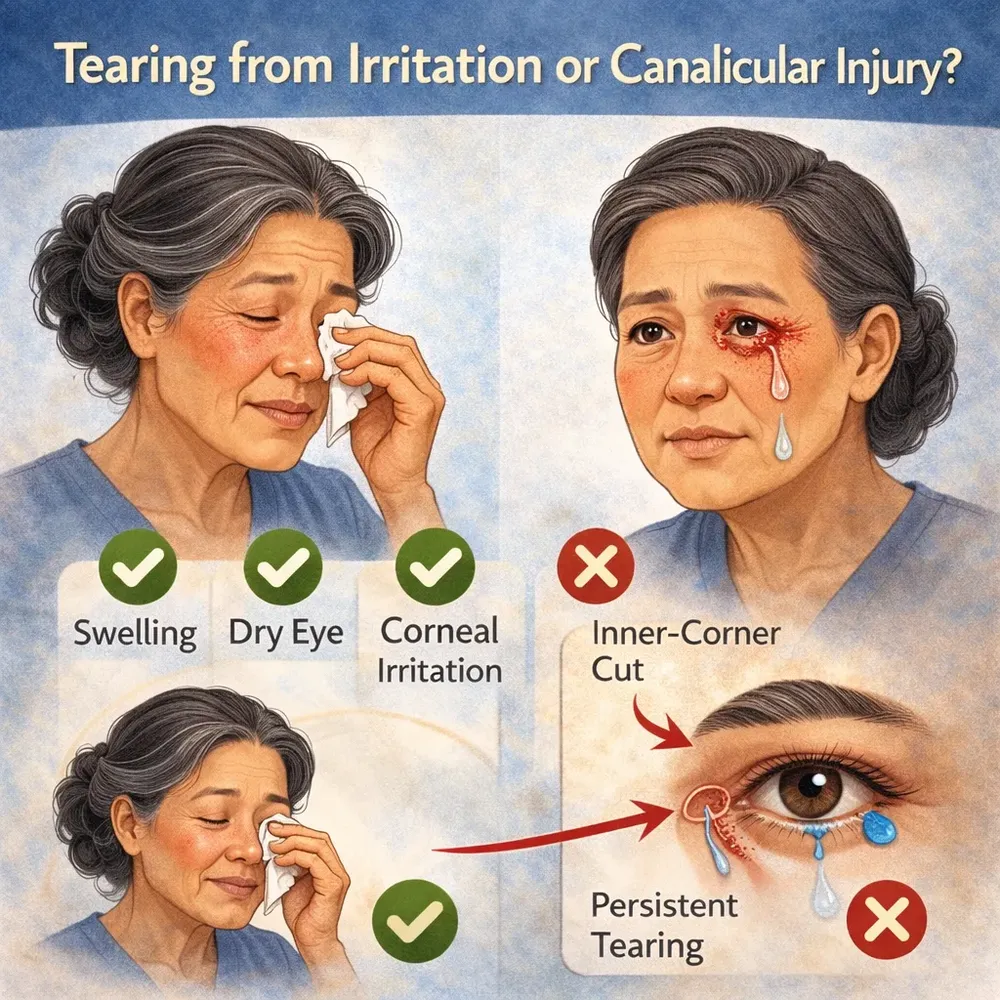
When tearing is from irritation instead
Swelling, dry eye, and corneal irritation can also cause tearing after trauma. In those cases, tearing often improves as the eye surface calms and swelling resolves.
What raises suspicion for canalicular injury is: inner-corner laceration + tearing that persists beyond the early healing window.
Follow-up: what it protects
- Confirms that eyelid contour and puncta position remain stable
- Tracks whether tearing is improving as swelling decreases
- Determines when a temporary stent can be removed (when used)
Follow-up is where “repair” becomes a reliable long-term result.

Frequently Asked Questions
Is stenting painful?
Most patients describe mild irritation at most. The stent is designed to be temporary and well tolerated during healing.
How soon should a tear duct injury be evaluated?
As soon as possible—especially with an inner-corner cut. Early alignment can improve the chance of normal drainage.
Can tearing be normal after an injury?
Yes—irritation and swelling can cause temporary tearing. Persistent tearing after an inner-corner laceration should be evaluated.
What should I do if symptoms change suddenly?
Sudden vision changes, severe pain, or rapidly worsening swelling should be evaluated urgently in person.
What should I do if symptoms change suddenly?
Sudden vision changes, severe pain, or rapidly worsening swelling should be evaluated urgently in person.
How can I tell if things are improving normally?
Normal recovery usually shows gradual improvement in comfort, swelling, and function over time. If you notice worsening pain, new vision changes, or a new functional limitation, seek in‑person evaluation.
Why See an Oculoplastic Surgeon?
Trauma care often needs a balance of function (vision, comfort, eyelid closure, tear drainage) and appearance (symmetry, natural contour). An oculoplastic surgeon is specifically trained for eyelid, tear duct, and orbital reconstruction.
Alexander Rabinovich, MD provides oculoplastic trauma evaluation and reconstruction in New York City and Brooklyn. Chronic tearing can affect daily life more than people expect. Getting the cause right early is the fastest path to relief.
Educational content only; not a substitute for medical advice. If you have sudden vision changes, severe pain, or worsening symptoms after an injury, seek urgent in-person care.
Book a Tear Duct Evaluation
For an overview of services and what we treat, visit Eye Trauma. You can also book a consultation below.

Leave a reply